
⚠️Severe weather may delay shipping to some US regions
lions-mane

Lion's Mane: The Nootropic Mushroom Your Brain Has Been Waiting For

Tanner GaucherMarch 12, 2026

7 min read · Filed under: Focus, Nootropics, Functional Mushrooms

There's a specific kind of mental fog that hits around 2pm — the kind that no amount of coffee fixes. You're not tired exactly. You're just… slower. Sentences take longer to form. Context-switching feels expensive. The tab you opened thirty seconds ago is already a mystery.

Most people reach for another espresso. A sharper few start asking why it's happening in the first place.

That question is what brought Lion's Mane (Hericium erinaceus) into serious nootropic conversation — not as a stimulant, but as something more interesting: a compound that may support the brain's own infrastructure over time.
What Lion's Mane Actually Does (At the Cellular Level)

The mechanism that sets Lion's Mane apart from every other "focus supplement" on the market comes down to two compound families found almost exclusively in this mushroom: hericenones (from the fruiting body) and erinacines (from the mycelium).

Both have been shown in research to stimulate the synthesis of Nerve Growth Factor (NGF) — a protein your brain uses to grow, maintain, and repair neurons, particularly in regions tied to memory and learning.

Here's why that matters: NGF doesn't cross the blood-brain barrier on its own. You can't supplement it directly. But hericenones and erinacines are small enough to cross, and once inside, they upregulate the signaling pathways that tell your brain to produce more NGF endogenously.

This is fundamentally different from stimulants. Caffeine forces alertness by blocking adenosine receptors. Lion's Mane works on the underlying hardware — supporting neuroplasticity and myelin sheath integrity rather than just making you feel more awake.

What the Clinical Data Shows

A 2020 systematic review published in the Journal of Medicinal Food examined multiple placebo-controlled trials on Lion's Mane and cognitive function. The consistent finding: supplementation was associated with meaningful improvements in cognitive performance scores, particularly in adults with mild cognitive impairment.

The landmark Mori et al. study (2009) remains the most cited: 30 adults with mild cognitive impairment took 3g/day of Lion's Mane powder over 16 weeks. The treatment group showed significantly higher scores on the Hasegawa Dementia Scale versus placebo — and those gains deteriorated within four weeks of stopping supplementation, suggesting the effect is ongoing rather than permanent.

More recent work has focused on younger, healthy populations. A 2023 study published in Nutrients found that a single dose of Lion's Mane extract improved performance on cognitive tasks measuring working memory and processing speed in adults aged 18–45. Effect onset: approximately 60 minutes post-dose.

None of this is "take this and become a genius" territory. The honest read is that Lion's Mane appears to support the conditions under which your brain performs at its ceiling — not by artificially raising that ceiling, but by reducing the friction underneath it.

Why Knowledge Workers Specifically Should Care

Cognitive decline is typically framed as an aging problem. But the conditions that accelerate it — chronic stress, sleep debt, inflammatory load, sustained context-switching — are exactly the working conditions of the modern professional.

NGF levels are suppressed by elevated cortisol. They're also suppressed by neuroinflammation, which low-grade chronic stress reliably produces. What you're left with is a brain that's structurally capable of performing well, but running on degraded infrastructure.

Lion's Mane doesn't fix the stressor. But it targets a real downstream mechanism with a reasonable body of evidence behind it — which puts it in a different category than most things marketed as "brain supplements."

Sourcing and Dosage: What to Actually Look For

Not all Lion's Mane products are equivalent, and the difference is significant enough to affect whether you'll see any benefit at all.

Fruiting body vs. mycelium on grain: The hericenones responsible for NGF stimulation are concentrated in the fruiting body. Many cheaper products are mycelium grown on grain substrate — essentially mushroom-inoculated oats — with very low actual beta-glucan and hericenone content. Look for "fruiting body" explicitly on the label, or a guaranteed beta-glucan percentage.

Extract ratio matters: A 4:1 or 8:1 hot-water extract means the bioactive compounds have been concentrated. Raw powder at comparable doses is not equivalent.

Dosage range in research: Studies have used anywhere from 500mg to 3g of extract daily. Most clinically relevant findings sit in the 1–1.5g range for extracted product.

Timing: For acute cognitive effects (per the 2023 Nutrients study), dosing roughly an hour before your most demanding cognitive work appears to be the optimal window. For long-term NGF support, consistency matters more than timing.

The Honest Expectation-Setting

Lion's Mane is not a shortcut. It won't rescue a bad night's sleep or override a fundamentally broken work schedule. What it does — with reasonable evidence behind it — is support the neurological infrastructure that your cognition runs on.

If you're already sleeping well, managing stress adequately, and eating reasonably, Lion's Mane is the kind of compound that compounds. The effect is subtle in the first few weeks and more apparent at the 8–12 week mark, which is also exactly why most people quit before they'd notice anything.

The people who get the most out of it are the ones playing the long game — optimizing the system, not just chasing the next spike.


Lion's Mane in the Nomad Stack

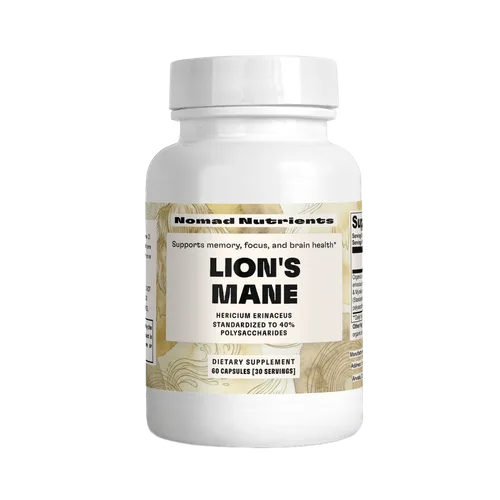
Lion's Mane is one of the anchor ingredients in our focus-oriented stack — selected specifically for fruiting body sourcing and extract concentration. If sustained cognitive performance is your primary wellness goal, that's where to start.

[[ INSERT STACK NAME + LINK ]]


References

  1. Mori K, et al. "Improving effects of the mushroom Yamabushitake on mild cognitive impairment." Phytotherapy Research, 2009.
  2. Docherty S, et al. "The Acute and Chronic Effects of Lion's Mane Mushroom Supplementation on Cognitive Function." Nutrients, 2023.
  3. Ghosh S, et al. "Systematic review of Lion's Mane mushroom and cognitive function." Journal of Medicinal Food, 2020.
  4. Kawagishi H, et al. "Hericenones and erinacines: stimulators of nerve growth factor biosynthesis." Phytochemistry Reviews, 2008.

Earn Free Products

Stack subscribers earn free products by referring friends

Learn more about stacks

*Referral Program: Share your unique link with friends. When a friend subscribes to a stack using your link and completes 2 consecutive shipments, you earn 1 product credit. Each credit is worth the median price of products in your current stack and can be redeemed for any product in our catalog — added as a bonus item to your next shipment. Credits have no cash value and cannot be transferred. Nomad Nutrients reserves the right to modify or discontinue the referral program at any time.

Founder’s Story

Tanner, Chief Mushroom Officer

"Hi, I'm Tanner, Chief Mushroom Officer at Nomad Nutrients. I built this for people like me—optimizers who want a flexible, all-in-one supplement stack without the hassle. Build yours, dial it in, and keep exploring."

— Tanner

Chief Mushroom Officer