
From the Lab[hpa·axis][rhodiola][rosavins]

Rhodiola Rosea: Two Compounds, Two Timelines, One Root

Tanner Gaucher
Nomad Editorial TeamReviewed by Tanner & Myco
March 3, 2026
Abstract

That first-week energy lift from Rhodiola isn't the main event — it's the opening act. Rhodiola contains two distinct compound classes operating on different timelines: salidroside drives acute monoamine effects (the lift), while rosavins drive long-term HPA axis recalibration (the resilience). Most people quit right when the compound transitions from stimulant mode to adaptogenic mode. This article maps both pathways, explains the timeline shift, and makes the case for staying past week three.

Rhodiola Rosea: Two Compounds, Two Timelines, One Root
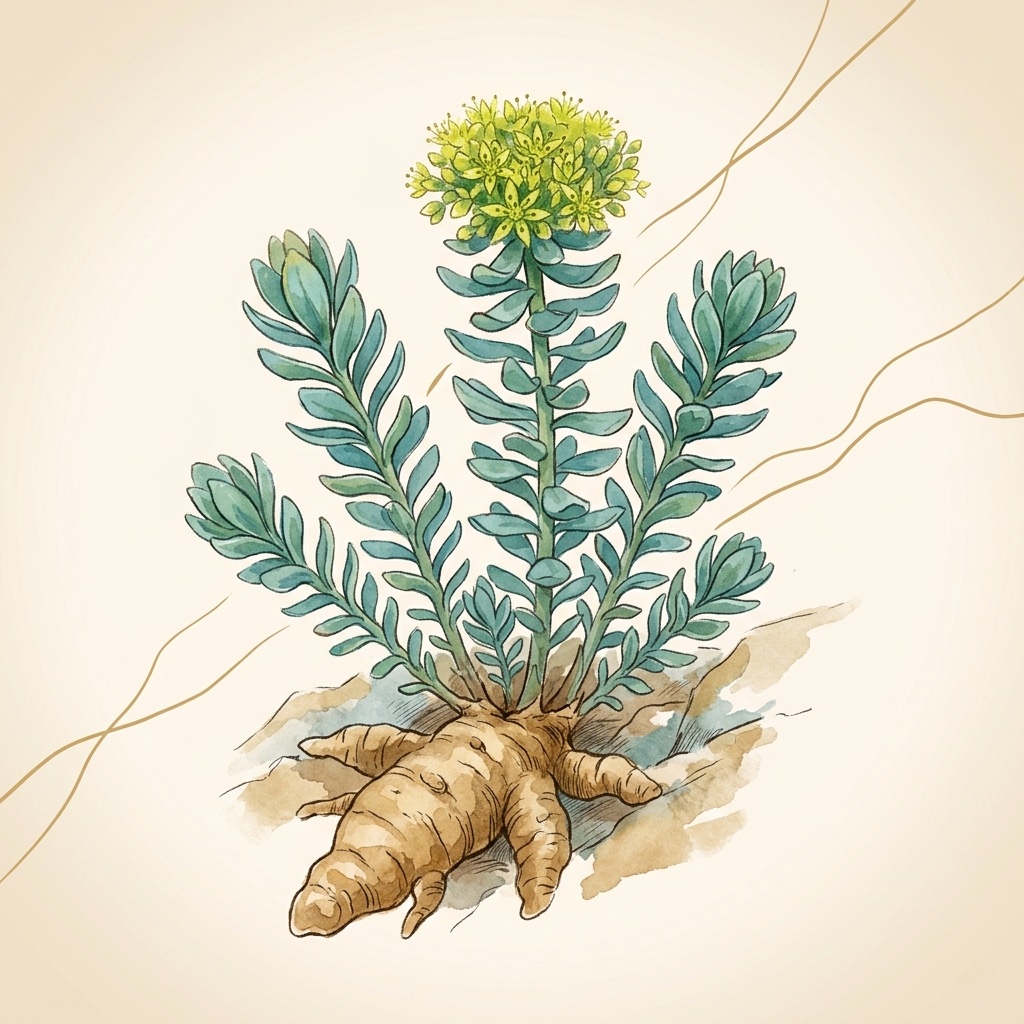
FIG.01

Metabolism Boost contains Salidroside + Rosavins

7 min read · Filed under: Energy, Stress, Adaptogens

First dose: unmistakable lift. Energy, clarity, motivation — it feels like the best version of caffeine without the jitter. So you keep taking it at the same dose, every morning, expecting that feeling to persist.

It doesn't. Within a few weeks, the acute stimulatory effect fades and something subtler takes its place: a quieter stress resilience, a wider window of composure under pressure.

This isn't a failure of the supplement. It's the compound working as intended. The confusion happens because Rhodiola rosea contains two distinct classes of active compounds that operate on different timelines and through different mechanisms — and most content about Rhodiola treats them as a single thing.

§ 01

Two Compounds, Two Timelines

Rhodiola rosea root contains over 140 identified compounds, but two matter for the effects people actually care about: salidroside and rosavins.

Salidroside is a phenylpropanoid glycoside. It drives Rhodiola's effects on monoamine neurotransmitters — serotonin, dopamine, and norepinephrine. Salidroside inhibits the enzymes MAO-A and COMT that degrade these neurotransmitters, allowing them to remain active in the synaptic cleft longer. This is the mechanism behind the acute stimulatory and mood-elevating effects that people notice on day one. It is, in simplified terms, a mild natural MAOI.

Rosavins (rosavin, rosin, and rosarin) are the compounds unique to Rhodiola rosea specifically — they don't appear in other Rhodiola species. Their mechanism is less fully characterized, but the evidence points toward HPA axis modulation. Rosavins appear to modulate cortisol output at the level of the adrenal cortex and may sensitize glucocorticoid receptors in the hypothalamus, tightening the negative feedback loop that tells your stress response to stand down.

Salidroside Rosavin Split
Click to expand
Salidroside vs. Rosavins: Compound SplitTwo active families in Rhodiola rosea with distinct biological targetsRhodiola Rosea ExtractSalidrosidePhenylpropanoid glycosidePrimary stress-buffer compound↑ Monoamine signaling (5-HT, DA, NE)HIF-1α neuroprotectionHeat-shock protein expression ↑Mitochondrial membrane protectionRosavinsCinnamyl glycosides (3 variants)Unique to Rhodiola roseaHPA axis modulation → cortisol ↓β-endorphin stabilizationSerotonin receptor sensitivity ↑Adaptogenic baseline regulationClinical standard: ≥3% rosavins + ≥1% salidroside for reproducible outcomes

The important distinction: salidroside gives you the acute effect. Rosavins give you the long-term adaptogenic effect. Most standardized extracts contain both, typically at a 3:1 rosavin-to-salidroside ratio (matching the natural ratio in the root). But some extracts are standardized to salidroside only, and some are rosavin-heavy. What you feel — and when you feel it — depends entirely on this ratio.

§ 02

What Happens Over the First Six Weeks

The first one to two weeks are dominated by salidroside's monoamine effects. Dopamine and norepinephrine levels in the prefrontal cortex increase. Subjectively, this registers as improved motivation, faster processing speed, and enhanced working memory. Multiple placebo-controlled studies have confirmed this acute effect, with improvements measurable within a single dose on cognitive tasks like serial subtraction and choice reaction time.

But the body adapts to monoamine modulation. Just as chronic caffeine use leads to adenosine receptor upregulation, chronic salidroside exposure triggers compensatory changes in monoamine receptor sensitivity. The acute lift attenuates. This is not tolerance in the recreational sense — it's homeostatic adjustment.

What replaces it is the rosavin-driven cortisol modulation, which takes longer to establish. HPA axis recalibration is not an overnight process. Glucocorticoid receptor sensitivity changes over weeks, not hours. By week three or four, the dominant effect shifts from "stimulant-like" to "stress-resilient." You don't feel a lift. You feel an absence — the absence of the cortisol spike you used to get from the inbox at 9am, the absence of the afternoon crash, the absence of the emotional reactivity that used to cost you an hour of focus recovery.

Acute Vs Chronic Response
Click to expand
Acute vs. Chronic Effects TimelineRhodiola operates simultaneously on two different timescales30 min2 hrsWeek 1Week 4Week 8Week 12Week 16ACUTE EFFECTS30 min – 2 hrs• Monoamine buffering• Fatigue perception ↓• Stress reactivity ↓MID-TERMWeeks 1–4• HPA recalibration begins• Cortisol normalizing• Mood baseline steadiesCHRONIC ADAPTATIONWeeks 8–16• Full cortisol modulation• Burnout protection• Cognitive resilience ↑• Neuroplasticity supportAcute stress bufferMid-term HPA adaptationSustained adaptogenic baselineAcuteMidLongEffect compounds with consistent daily use — minimum 8–12 week evaluation window

That shift is the feature, not the bug. But it confuses people who were chasing the day-one feeling, and many of them quit Rhodiola right when it's transitioning into its most valuable mode.

§ 03

The Clinical Signal

Rhodiola has one of the stronger evidence bases among adaptogens, though it still lags behind pharmaceutical-grade research.

A 2012 systematic review covering 11 randomized controlled trials found consistent evidence for reduced fatigue and improved cognitive function under stress, with the strongest effects appearing in studies of physically and mentally demanding conditions — shift workers, medical residents, military cadets. The magnitude of effect was moderate, and the authors noted that most trials were of short to medium duration.

The most relevant study for the Nomad Nutrients audience: Olsson et al. (2009) gave 60 subjects 576 mg of Rhodiola extract daily for 28 days and measured stress-related fatigue. The treatment group showed significant improvement compared to placebo, with cortisol awakening response — a reliable biomarker of HPA axis regulation — normalizing toward healthy reference ranges.

One underappreciated finding: Rhodiola appears to be most effective in people who are already under chronic stress. In well-rested, low-stress populations, the effects are much smaller. This makes pharmacological sense — if your HPA axis is already well-regulated and your monoamine levels are balanced, there's less for Rhodiola to correct.

§ 04

Sourcing and Standardization

Not all Rhodiola products are equivalent, and the species matters. Rhodiola rosea is the studied species — products labeled simply "Rhodiola" or using other species (R. crenulata, R. imbricata) do not contain rosavins and won't produce the long-term adaptogenic effect.

Look for extracts standardized to 3% rosavins and 1% salidroside, matching the natural root ratio and the ratio used in most clinical research. Products that standardize to salidroside only are optimizing for the acute stimulatory effect at the expense of long-term HPA axis modulation.

Root extract is what you want. Aerial parts (leaves, stems) have a different compound profile and less research backing.

§ 05

Dosage and Timing

Standard dosing: 200 to 600 mg daily of a standardized extract. Take it in the morning or early afternoon — the monoamine effects can interfere with sleep if dosed too late.

For acute cognitive support: a single dose of 200 to 300 mg taken 30 to 60 minutes before demanding work. For long-term adaptogenic benefit: daily use for at least four to six weeks to allow HPA axis recalibration.

Cycling — three weeks on, one week off — is a reasonable precaution given what we know about monoamine receptor adaptation, though the evidence is more theoretical than clinical. The Nomad Nutrients approach is to build this into the Smart Stack rotation so you don't have to think about it.

Metabolism Boost
Featured in this article

Metabolism Boost

$18.68$24.90Stack price
View details →
§ 06

The Honest Frame

Rhodiola is the adaptogen for people who need to perform under pressure without sedation. If your failure mode is burnout-driven paralysis — knowing what to do but lacking the neurochemical drive to start — Rhodiola addresses that directly. If your failure mode is anxiety and hyperactivation, ashwagandha is the better match.

The day-one feeling fades. What replaces it is better. Give it the six weeks to get there.

§ 07

References

  1. Hung SK, et al. "The effectiveness and efficacy of Rhodiola rosea: a systematic review of randomized clinical trials." Phytomedicine, 2011.
  2. Olsson EM, et al. "A randomised, double-blind, placebo-controlled, parallel-group study of the standardised extract SHR-5 of the roots of Rhodiola rosea in the treatment of subjects with stress-related fatigue." Planta Medica, 2009.
  3. Cropley M, et al. "The effect of Rhodiola rosea supplementation on cognitive performance, working memory and cortisol secretion." Phytotherapy Research, 2015.
  4. Panossian A, et al. "Rosenroot (Rhodiola rosea): traditional use, chemical composition, pharmacology and clinical efficacy." Phytomedicine, 2010.
  5. Darbinyan V, et al. "Rhodiola rosea in stress induced fatigue — a double blind cross-over study." Phytomedicine, 2000.

By email

Want the short version?

Five short emails over two weeks: the daily basics, the 2pm crash, what’s in mushroom coffee, long stretches of stress, and how a stack works.

Apply the research

Stack it while the research is fresh.

Pick three compounds. Myco handles the cycling schedule and ships only when you're running low.

Build your stack →

References

3 peer-reviewed
  1. 01Agapouda A, Grimm A, Lejri I, et al.. Oxidative medicine and cellular longevity, 2022. Rhodiola Rosea Extract Counteracts Stress in an Adaptogenic Response Curve Manner via Elimination of ROS and Induction of Neurite Outgrowth. Vol 2022, 5647599.
  2. 02Tinsley GM, Jagim AR, Potter GDM, et al.. The British journal of nutrition, 2024. Rhodiola rosea as an adaptogen to enhance exercise performance: a review of the literature. Vol 131(3), 461-473.
  3. 03Koozehchian MS, Newton AT, Mabrey G, et al.. Nutrients, 2025. Dose-Response Effects of Short-Term Rhodiola rosea (Golden Root Extract) Supplementation on Anaerobic Exercise Performance and Cognitive Function in Resistance-Trained Athletes: A Randomized, Crossover, Double-Blind, and Placebo-Controlled Study. Vol 17(23).
Apply the research

Build a stack around what you just read.

Pick three compounds. Myco handles the cycling protocol and ships only when you're running low.

Save up to 25%Free shipping over $35Cancel anytime
Metabolism Boost

Build a stack with this article

Metabolism Boost+ 1 more

Build Stack

Comments

Leave a Comment

From the Journal

Keep reading.

01 / 13
The Science of Adaptogens: How Your Body's Stress Response Actually Works
Journal · Calm
RelatedJan 5, 2026

The Science of Adaptogens: How Your Body's Stress Response Actually Works

Adaptogen" has become a marketing term. The pharmacological category is real — here's the actual mechanism behind the HPA axis, allostatic load, and what each major adaptogen is specifically doing.

Ashwagandha With Black Pepper
Read article→
Mushroom Coffee: What's Actually in the Cup (And What Isn't)
Journal · Focus
Oct 7, 2026

Mushroom Coffee: What's Actually in the Cup (And What Isn't)

Mushroom coffee is sold on ritual. We read our own label instead: how much of each mushroom is in a serving, powder vs. extract, the caffeine question, and when a capsule makes more sense.

Mushroom Fuse Instant Coffee Medium Roast
Lions Mane
Mushroom Energy Cognition Drops
Read article→
5 Ways Holiday Travel Wears You Down (And the Carry-On Fix for Each)
Journal · Recovery
Oct 7, 2026

5 Ways Holiday Travel Wears You Down (And the Carry-On Fix for Each)

Holiday travel isn't one problem. It's five, stacked into a single day. Here's what each one does, and the carry-on format that handles it.

Hydration Powder Lychee
Sleep Strips
Mushroom 10x Gummies
Reishi Calm Drops
Cordyceps Energy Plus Gummies
Read article→
4 Things Heating Season Does to Your Skin (And the Fix for Each)
Journal · Glow
Oct 7, 2026

4 Things Heating Season Does to Your Skin (And the Fix for Each)

Turning the heat on dries the air indoors. Your skin feels it within a week. Here's what changes, and the fix for each layer, from the surface down to the dermis.

Pdrn Brightening Serum
Tallow Cream Orange Bergamot
Collagen Creamer Vanilla
Gua Sha Face Oil
Read article→
Oral GABA: Does It Actually Reach Your Brain?
Journal · Calm
Oct 1, 2026

Oral GABA: Does It Actually Reach Your Brain?

GABA is the brain's main brake pedal. Whether swallowing it presses that pedal is an open question. Here is what the human trials show, and how we dose around the gap.

Alpha Chill Strips
Reishi Balance Chill Gummies
Botanical Sleep Complex
Read article→
The Performance Stack for People Who Sit All Day and Train Anyway
Journal · Performance
Oct 1, 2026

The Performance Stack for People Who Sit All Day and Train Anyway

Eight hours at a desk, then an hour under a bar. Four compounds for the person doing both, each on the schedule our Smart Cycling protocol gives it.

Creatine Monohydrate
Whey Protein Vanilla
Maca Plus
Stamina Herbal Complex
Read article→

Founder’s Story

Tanner, Chief Mushroom Officer

"Hi, I'm Tanner. I built Nomad for optimizers who want a real system — not just a subscription. You choose the direction, we handle the navigation. Pick your path and we'll keep you dialed in."

— Tanner

Chief Mushroom Officer