
7 min read · Filed under: Energy, Athletic Performance, Functional Mushrooms
There's a specific frustration that comes with being fit on paper but underperforming in practice. You train consistently. Your resting heart rate is reasonable. But your cardiovascular ceiling feels lower than it should — you gas out earlier than your fitness level should allow, recovery between efforts is slower than you'd expect, and the energy output at the threshold of hard effort isn't where it used to be.
Most people attribute this to age, overtraining, or insufficient sleep. Those are real factors. But there's a less-discussed upstream variable: the efficiency of the cellular machinery that generates energy under aerobic demand. This is precisely where Cordyceps operates.
The Energy System It Targets
To understand Cordyceps, you need to understand what limits aerobic performance at the cellular level — because it's not always what people assume.
VO2 max — maximum oxygen uptake — is the standard measure of aerobic capacity. It reflects the rate at which your cardiovascular system can deliver oxygen to working muscle and your mitochondria can use it to generate ATP. Training improves VO2 max primarily by increasing cardiac output, capillary density, and mitochondrial volume. These are structural adaptations that take months to build.
But there's a second variable that gets less attention: mitochondrial efficiency — how effectively your mitochondria convert available oxygen into ATP, given the structural capacity they have. Two athletes with identical VO2 max scores can have meaningfully different performance outcomes if their mitochondrial machinery is running at different efficiency levels.
This is the layer Cordyceps targets.
Cordycepin: The Core Mechanism
Cordyceps' primary bioactive is cordycepin — chemically known as 3'-deoxyadenosine. The name is the mechanism: it's a structural analogue of adenosine with a single modification at the 3' carbon position (a missing hydroxyl group, hence "deoxy").
Adenosine is not just a sleep-pressure molecule — it's also the direct building block of ATP (adenosine triphosphate) and AMP (adenosine monophosphate), and a key regulator of cellular energy metabolism through purinergic signaling. When cells are under energy stress — when ATP demand exceeds supply — AMP accumulates, which activates AMPK (AMP-activated protein kinase): the master cellular energy sensor.
AMPK activation triggers a cascade of metabolic adaptations: increased glucose uptake, enhanced fatty acid oxidation, mitochondrial biogenesis signaling, and improved oxygen utilization efficiency. It's essentially the cellular response to "we need more energy capacity."
Cordycepin, as an adenosine analogue, interacts with adenosine receptors — particularly A1 and A2A receptors — and modulates purinergic signaling in ways that influence AMPK activation and downstream energy metabolism. Additionally, cordycepin has demonstrated inhibition of phosphodiesterases (PDEs) — enzymes that break down cyclic AMP (cAMP). Higher cAMP levels amplify the cellular energy signaling cascade, supporting mitochondrial function and oxygen utilization efficiency.
The net effect at the tissue level: improved ATP synthesis efficiency under aerobic demand, better oxygen utilization per unit of mitochondrial capacity, and enhanced recovery kinetics between efforts.
The Oxygen Utilization Piece
Beyond cordycepin's direct purinergic effects, Cordyceps has demonstrated effects on oxygen delivery and utilization through a secondary mechanism.
Research has shown that Cordyceps supplementation increases red blood cell 2,3-bisphosphoglycerate (2,3-BPG) levels. 2,3-BPG is a molecule that binds hemoglobin and reduces its oxygen affinity — causing hemoglobin to release oxygen more readily at the tissue level. This is the same adaptation that occurs naturally with altitude training: at low oxygen availability, the body increases 2,3-BPG to extract more oxygen from each hemoglobin molecule passing through the capillaries.
Cordyceps appears to partially replicate this mechanism at sea level. More efficient oxygen unloading from hemoglobin at the muscle means more oxygen available to mitochondria per unit of blood flow — improving aerobic efficiency without requiring cardiovascular structural changes.
This is why the altitude training comparison gets made in athletic circles: Cordyceps doesn't replace the structural adaptations of training, but it supports the oxygen utilization efficiency that altitude training improves through a different mechanism.
What the Clinical Data Shows
A 2016 study published in the Journal of Dietary Supplements examined the effects of Cordyceps militaris supplementation on aerobic performance in young adults over three weeks. The treatment group showed significantly greater improvements in VO2 max and ventilatory threshold compared to placebo — the ventilatory threshold finding being particularly relevant, as this is the intensity at which breathing becomes labored and sustainable output begins to drop.
A 2010 study in the same journal using Cordyceps sinensis extract found that supplementation over 12 weeks significantly increased VO2 max in older adults, alongside improvements in metabolic threshold and time to exhaustion.
The effect sizes are meaningful but not dramatic — Cordyceps is not producing the equivalent of EPO or altitude camp. What it consistently shows is a measurable improvement in aerobic efficiency metrics, particularly in populations not at their genetic ceiling for cardiovascular adaptation (which, practically speaking, is most people).
The Desk Athlete Profile
The professional who runs, bikes, or trains outside work hours has a specific physiology challenge that pure athletes don't face: they're training their aerobic system in the hours after a day of sustained cognitive demand, often on compromised sleep, with elevated cortisol from work stress.
Cortisol chronically suppresses mitochondrial biogenesis signaling. Sleep debt reduces growth hormone output and impairs muscular recovery. These factors don't prevent adaptation, but they slow it — the gains from training accumulate more slowly than they would under ideal conditions.
Cordyceps addresses this at the mitochondrial efficiency level — supporting the energy machinery's output under the conditions that actually exist, rather than the optimized conditions that don't. Better oxygen utilization efficiency means more output from the training stimulus you're able to apply. Better ATP synthesis efficiency means shorter recovery windows between hard efforts.
It's not about manufacturing fitness you haven't earned. It's about reducing the gap between the fitness you've built and the performance that fitness should produce.
Species Notes: Militaris vs. Sinensis
Two Cordyceps species dominate the supplement market, and the distinction is practical.
Cordyceps sinensis is the wild Himalayan species with the longest traditional use history. It parasitizes ghost moth larvae at high altitude, producing the "caterpillar fungus" familiar from traditional Chinese medicine. It's extraordinarily expensive, frequently adulterated, and nearly impossible to cultivate authentically. Authentic wild C. sinensis costs hundreds of dollars per gram.
Cordyceps militaris is a related species that can be cultivated reliably and actually contains higher concentrations of cordycepin than wild C. sinensis. Most human clinical trials published in the last decade use C. militaris for exactly this reason — it's the species with consistent, verifiable bioactive content. The research profile for militaris is now stronger than for sinensis in many applications.
Most quality Cordyceps supplements on the market use C. militaris. If a product claims to be C. sinensis at a standard supplement price point, that claim warrants skepticism.
Dosage and Timing
Research protocols have used 1–3g daily of Cordyceps extract, with some trials using higher doses for shorter periods. For athletic performance applications, pre-workout or morning dosing aligns with the goal — you want the oxygen utilization effects active during training, not just at baseline.
Cordycepin content varies significantly between products. As with all functional mushrooms: fruiting body sourcing, extraction method, and third-party verification of bioactive content are the relevant quality signals. A standardized cordycepin percentage is the most direct quality indicator.
Cordyceps is well-tolerated with no significant adverse effects documented at studied doses. It is occasionally contraindicated in autoimmune conditions given its immune-modulating properties — those with autoimmune diagnoses should consult a physician before use.
The Honest Frame
Cordyceps won't transform a recreational runner into an athlete. It won't replace training, recovery, or sleep. What the mechanism and the data together suggest is that it meaningfully supports mitochondrial efficiency and oxygen utilization — reducing the gap between the aerobic capacity you've developed and the performance that capacity should theoretically produce.
For the professional who trains hard in the margins of a demanding schedule and finds performance stubbornly plateaued relative to the effort they're investing, this is a compound worth taking seriously. The mechanism is real, the species distinction matters, and the extraction quality determines whether you're getting any of it.
Cordyceps in the Nomad Stack
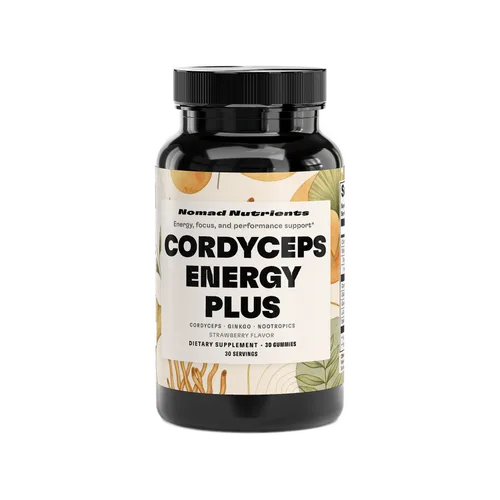
If energy and athletic performance are your primary wellness goal, we've built a stack around it.
[[ INSERT STACK NAME + LINK ]]
References
- Hirsch KR, et al. "Cordyceps militaris improves tolerance to high intensity exercise after acute and chronic supplementation." Journal of Dietary Supplements, 2016.
- Chen S, et al. "Effect of Cs-4 (Cordyceps sinensis) on exercise performance in healthy older subjects." Journal of Alternative and Complementary Medicine, 2010.
- Manabe N, et al. "Effects of the mycelial extract of cultured Cordyceps sinensis on in vivo hepatic energy metabolism in mice." Japanese Journal of Pharmacology, 1996.
- Tan W, et al. "Cordycepin inhibits lipopolysaccharide-induced inflammation via adenosine receptor and AMPK signaling." European Journal of Pharmacology, 2014.
- Ko WS, et al. "Cordycepin-mediated enhancement of 2,3-BPG in erythrocytes." Life Sciences, 2020.