7 min read · Filed under: Nutrition, Anti-Inflammatory, Foundations
Green powders have a trust problem. Most of them are proprietary blends with undisclosed doses, optimized for label real estate rather than actual nutrient delivery. The serving sizes are small, the ingredient lists are long, and the nutritional contribution per gram of most formulations is underwhelming relative to the marketing language surrounding them.
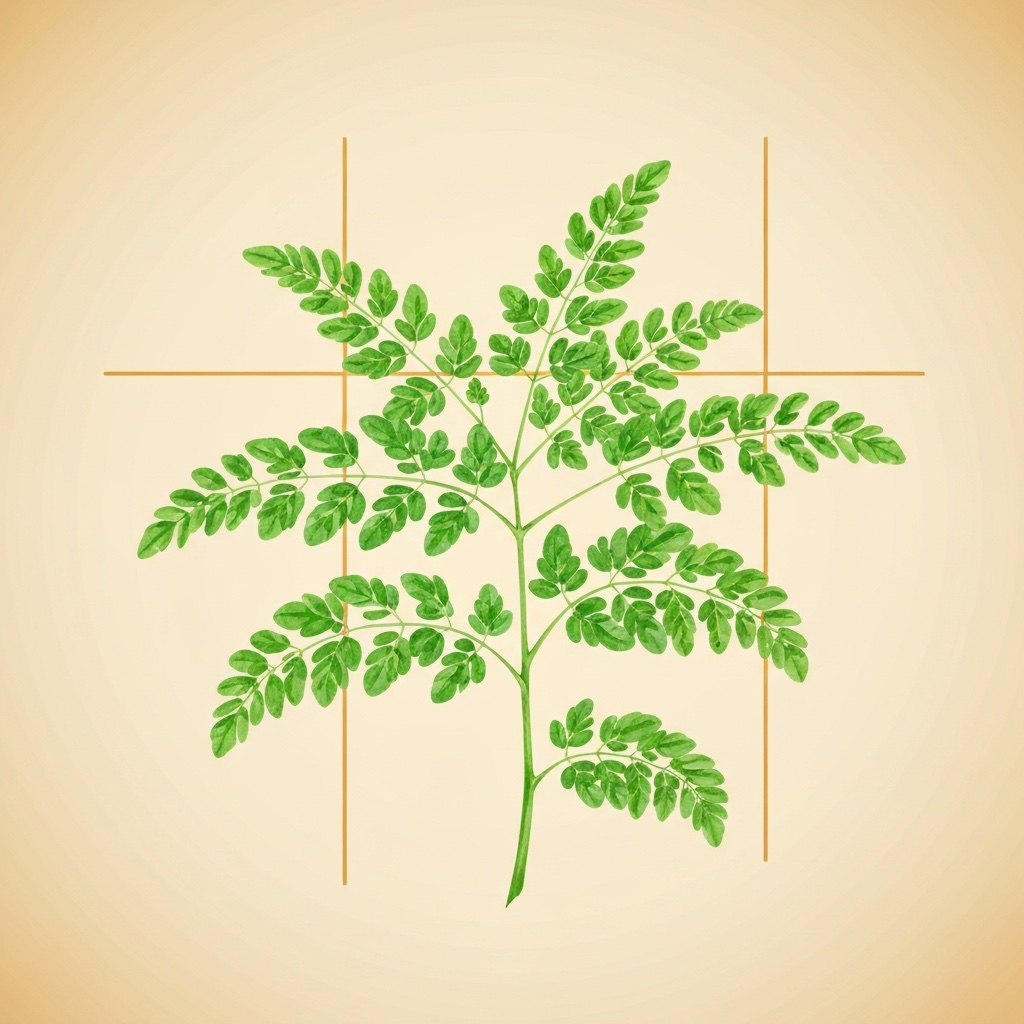
Moringa (Moringa oleifera) is not a green powder in that sense. It's a single-ingredient leaf powder from a tree native to South Asia and widely cultivated across tropical and subtropical regions — and its nutrient density per gram is legitimately unusual. Unusual enough that it warrants examining the numbers directly rather than relying on the superfood framing that accompanies most moringa content.
The Nutrient Density Case: What the Numbers Actually Show
Moringa leaf powder's nutritional profile per gram is among the most concentrated of any whole food, across multiple nutrient categories simultaneously. This is the relevant comparison — not absolute quantities (which are dose-dependent) but density per gram, since that's what determines how much nutritional work a serving is doing.
Protein: Moringa leaf powder contains approximately 25–30% protein by dry weight — comparable to legumes, and unusually high for a leaf. More importantly, the protein contains all nine essential amino acids, making it a complete protein source — rare among plant foods. The amino acid profile is particularly notable for its lysine content, an essential amino acid commonly limiting in plant-based diets.
Vitamin C: Gram-for-gram, dried moringa leaf contains approximately 7x the vitamin C of oranges. The caveat: vitamin C is heat-sensitive and degrades during drying. The actual vitamin C content of a commercial moringa powder depends heavily on the drying method — low-temperature (shade or freeze) drying preserves significantly more than high-heat processing.
Calcium: Approximately 4x the calcium density of whole milk per gram. Bioavailability of plant calcium varies depending on oxalate content (which can bind calcium and reduce absorption) — moringa's oxalate levels are moderate and not high enough to negate its calcium contribution, but absorption is somewhat lower than dairy calcium.
Iron: Significantly higher iron density than spinach per gram, though again, non-heme iron from plant sources has lower bioavailability than heme iron from animal sources. Vitamin C consumed alongside moringa enhances non-heme iron absorption — a useful pairing given moringa's own vitamin C content (before heat degradation) or a separate vitamin C source.
Potassium: Approximately 3x the potassium density of bananas per gram.
B vitamins: Meaningful concentrations of B2 (riboflavin), B3 (niacin), B6, and folate.
The honest read on these comparisons: they're accurate on a per-gram basis and the nutrient density is genuinely high. The practical qualification is that standard serving sizes for moringa powder (typically 3–10g) mean the absolute nutrient contribution is meaningful as a daily supplement but not equivalent to eating the foods compared. Moringa is a dense nutritional complement, not a replacement for a varied diet.
The Isothiocyanate Mechanism: Beyond Basic Nutrition
If moringa's story were only nutrient density, it would be interesting but not particularly differentiated from other leafy vegetables in concentrated form. The more pharmacologically interesting component is its isothiocyanate content — specifically moringin (4-[α-L-rhamnosyloxy]benzyl isothiocyanate), a compound largely unique to the Moringaceae family.
Isothiocyanates are sulfur-containing compounds produced when the enzyme myrosinase acts on glucosinolate precursors — the same reaction responsible for the pungent taste of mustard, wasabi, and cruciferous vegetables like broccoli. The most well-studied dietary isothiocyanate is sulforaphane from broccoli sprouts; moringin is moringa's functional equivalent.
Nrf2 pathway activation: Isothiocyanates activate the Nrf2 (Nuclear factor erythroid 2-related factor 2) transcription pathway — one of the primary cellular defense systems against oxidative stress and inflammation. Nrf2 is normally held inactive in the cytoplasm bound to its inhibitor Keap1. Isothiocyanates react with cysteine residues on Keap1, disrupting the complex and allowing Nrf2 to translocate to the nucleus. There, it binds antioxidant response elements (ARE) and upregulates transcription of a broad battery of cytoprotective enzymes: glutathione S-transferases, NAD(P)H quinone oxidoreductase (NQO1), heme oxygenase-1 (HO-1), and others.
The result is a comprehensive upregulation of the cell's endogenous antioxidant and detoxification machinery — not direct antioxidant activity (adding antioxidant molecules to quench free radicals) but induction of the systems that manage oxidative stress continuously. This is a mechanistically superior approach to antioxidant support because it's adaptive and self-regulating rather than dependent on the presence of exogenous molecules.
NF-κB inhibition: Moringin also inhibits NF-κB signaling — the master transcription factor for inflammatory gene expression that was mentioned in the betulinic acid discussion. NF-κB drives production of pro-inflammatory cytokines (IL-1β, IL-6, TNF-α) and COX-2 (the enzyme targeted by NSAIDs). By suppressing NF-κB activation, moringa's isothiocyanates reduce the inflammatory signal cascade downstream of chronic stressors — whether those stressors are dietary, environmental, or metabolic.
Blood glucose modulation: Moringa leaf extracts have demonstrated consistent blood glucose-lowering effects in multiple animal models and several human studies, with mechanisms involving improved insulin sensitivity and inhibition of intestinal glucose absorption. A 2016 study in healthy adults found that moringa leaf powder added to a meal significantly reduced the postprandial blood glucose response compared to the same meal without moringa. For professionals whose cortisol exposure and irregular eating patterns predispose them to blood glucose variability, this is a relevant functional benefit.
Why It Works for People Who Hate Green Powders
The barrier to consistent greens supplementation for most people is taste — the grassy, bitter, sometimes sulfurous flavor profile of generic greens blends, which makes daily compliance genuinely unpleasant rather than just inconvenient.
Moringa has a mild, slightly earthy taste that's significantly more neutral than most greens powders and most other single-ingredient leaf powders (wheatgrass, spirulina). This isn't a trivial observation — a supplement that gets taken consistently is infinitely more effective than one that gets abandoned after two weeks because it makes every smoothie taste like a lawn.
The neutral profile means it mixes into coffee, smoothies, or water without substantially altering the flavor — which is the practical requirement for daily compliance.
Sourcing and Processing: Where Quality Diverges
Moringa quality varies significantly based on geography, harvest timing, and processing method.
Geography and variety: Moringa oleifera is the primary cultivated species. Soil quality and climate affect mineral content — Indian and East African sources have the most documented nutritional profiles. "Moringa" on a label without origin disclosure is not necessarily a red flag, but origin transparency is a positive signal.
Harvest timing: Young leaves (harvested before the tree matures) have higher nutrient density and lower fiber content than older leaves. Premium products specify harvest timing or use a leaf grade designation.
Drying method — the critical variable: Nutrient retention depends heavily on processing temperature. Conventional high-heat drying (above 60°C) destroys heat-sensitive vitamins (particularly vitamin C and some B vitamins) and degrades the isothiocyanate content — myrosinase, the enzyme required to convert glucosinolate precursors to active moringin, is heat-sensitive. Shade drying or low-temperature processing preserves both heat-labile vitamins and isothiocyanate precursor activity.
A product that specifies low-temperature or shade drying is making a meaningful quality claim. A product that doesn't specify should be assumed to use conventional processing.
No solvents or additives: The best moringa products are simply dried, ground leaf — nothing added. Some products blend moringa with other ingredients; this dilutes the concentration and makes nutrient density claims less interpretable.
Dosage and Practical Use
Research on moringa has used doses ranging from 2–10g daily of leaf powder. The blood glucose studies showing postprandial effects used moringa added directly to meals. The anti-inflammatory and antioxidant effects are consistent across this dose range.
Practical protocol: 3–5g daily mixed into a morning smoothie, coffee, or water covers the nutritional contribution and delivers meaningful isothiocyanate exposure at typical serving sizes.
Timing: Taking moringa with meals makes practical sense given the postprandial glucose-modulating effects — the mechanism works when the compound is present during digestion.
Vitamin C pairing: To maximize non-heme iron absorption from moringa, a vitamin C source at the same meal enhances uptake — particularly relevant for those relying on moringa as a significant iron source.
Pregnancy note: Moringa root and bark contain compounds that may stimulate uterine contractions — these are not present in meaningful quantities in leaf powder, but standard caution applies: leaf powder is considered safe, root preparations are not.
The Honest Summary
Moringa is not magic. It's a leaf from a tree with an unusually concentrated nutritional profile and a specific isothiocyanate compound that activates meaningful cellular defense mechanisms. The nutrient density numbers are accurate, the Nrf2 pathway activation is a real and well-characterized mechanism, and the blood glucose data is consistent enough to be actionable.
What it is not: a replacement for dietary variety, a pharmaceutical intervention, or a compound with the depth of clinical evidence that something like ashwagandha or creatine carries. It's a nutritional tool — one that does an unusual amount of work per gram and has a compliance profile (mild taste, simple format) that gives it a realistic chance of actually becoming a daily habit.
For someone who isn't reliably getting a diverse intake of vegetables and wants a single daily addition that covers nutritional gaps and adds functional phytochemical benefits: the case for moringa is stronger than the case for most greens supplements currently on the market.
Moringa in the Nomad Stack
If daily nutritional foundations and anti-inflammatory support are your primary wellness goals, we've built a stack around it.
[[ INSERT STACK NAME + LINK ]]
References
- Rockwood JL, et al. "In vitro and in vivo anti-oxidative activity of moringa oleifera leaf powder." Journal of Biological Sciences, 2013.
- Leone A, et al. "Moringa oleifera seeds and oil: characteristics and uses for human health." International Journal of Molecular Sciences, 2016.
- Jaiswal D, et al. "Effect of Moringa oleifera Lam. leaves aqueous extract therapy on hyperglycemic rats." Journal of Ethnopharmacology, 2009.
- Waterman C, et al. "Isothiocyanate-rich moringa oleifera extract reduces inflammatory markers in hyperlipidemic adults." Phytotherapy Research, 2015.
- Fahey JW. "Moringa oleifera: a review of the medical evidence for its nutritional, therapeutic, and prophylactic properties." Trees for Life Journal, 2005.