9 min read · Filed under: Cognitive Performance, Mitochondrial Health, Advanced Protocols
Methylene blue has one of the stranger origin stories in the nootropic space. It was synthesized in 1876 by German chemist Heinrich Caro, initially as a textile dye — the first fully synthetic pharmaceutical compound ever produced. Within a decade it was being used to treat malaria. It went on to become the first synthetic drug approved for medical use in the United States. Today it's a listed essential medicine by the World Health Organization, used in hospitals for methemoglobinemia and as a surgical tissue marker.
It's also, at low doses, one of the more mechanistically interesting cognitive performance compounds available — and it's arrived in the biohacker conversation for a reason that has nothing to do with its history as a dye.
The reason is the mitochondrial electron transport chain. And to understand why methylene blue is genuinely interesting there, you need to understand what an electron carrier actually does.
The Electron Transport Chain: A Brief Primer
The mitochondrial electron transport chain (ETC) is the final stage of cellular respiration — the process by which your mitochondria convert nutrients into ATP. It consists of four protein complexes (Complex I–IV) embedded in the inner mitochondrial membrane, connected by two mobile electron carriers: ubiquinone (CoQ10) and cytochrome c.
The chain works by passing electrons down a series of redox reactions — each complex accepts electrons from the previous carrier, extracts energy from the transfer, and passes them to the next. At the end of the chain, Complex IV transfers electrons to oxygen, producing water. The energy extracted at each step is used to pump protons across the membrane, creating an electrochemical gradient that drives ATP synthase.
The efficiency of this system depends on uninterrupted electron flow. When the chain is disrupted — by oxidative damage to the complexes, by insufficient CoQ10 or cytochrome c availability, or by mitochondrial dysfunction — electrons leak from the chain and react with oxygen before reaching Complex IV. This produces reactive oxygen species (ROS) — superoxide and hydrogen peroxide — which damage mitochondrial membranes, proteins, and DNA, creating a feedback loop of progressive mitochondrial dysfunction.
Where Methylene Blue Fits
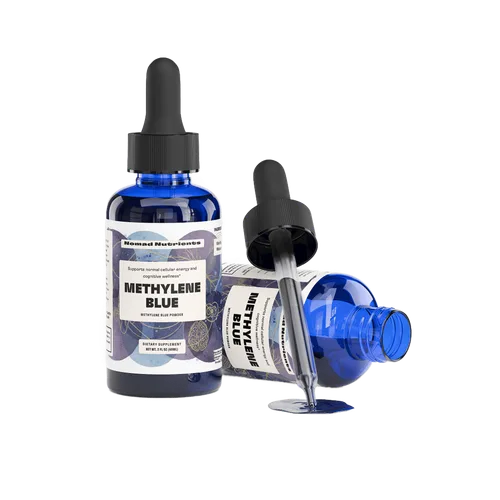
Methylene blue is a redox-active molecule — it exists in two interconvertible states: oxidized (methylene blue, blue color) and reduced (leucomethylene blue, colorless). This redox cycling is the core of its mechanism.
In the mitochondria, methylene blue functions as an alternative electron carrier — it can accept electrons directly from NADH (bypassing Complex I) and donate them to cytochrome c (bypassing Complexes II and III), effectively creating a shortcut through the electron transport chain.
This has two significant consequences:
First, it maintains electron flow when the standard chain is disrupted. When Complex I or Complex III are dysfunctional — due to oxidative damage, age-related decline, or metabolic stress — methylene blue keeps electrons moving through an alternative route. ATP synthesis continues. The energy crisis that would otherwise result is partially bypassed.
Second, it reduces electron leak and ROS production. By providing an alternative pathway that keeps electrons moving efficiently, methylene blue reduces the probability of electrons escaping the chain and reacting with oxygen. Fewer escaped electrons mean fewer superoxide radicals — less mitochondrial oxidative damage, less inflammatory signaling, better preservation of mitochondrial membrane integrity over time.
This is the mechanistic basis for methylene blue's cellular effects: not stimulation, not receptor activation, but direct participation in the electron transfer chemistry that generates cellular energy.
The Cognitive Effects: Low-Dose Hormesis
Here the dose-response relationship is critical — and unusual.
Methylene blue shows an inverted U-shaped dose-response curve for cognitive effects. Low doses enhance cognitive function. High doses impair it. This is not a simple "more is better" compound, and understanding why requires the hormesis concept.
At low doses (typically characterized in research as approximately 0.5–4mg/kg body weight for cognitive applications), methylene blue's electron cycling activity enhances mitochondrial function in neurons — improving ATP availability in the high-energy-demand regions of the prefrontal cortex and hippocampus. It also shows monoamine oxidase inhibition (MAO-I) activity at low doses — slowing the breakdown of dopamine, serotonin, and norepinephrine, increasing neurotransmitter availability in ways that support mood, motivation, and cognitive clarity.
Additionally, low-dose methylene blue upregulates cytochrome c oxidase (Complex IV) expression — increasing the total number of the final electron acceptor complex in the chain. More Complex IV means higher ceiling for electron transport capacity and ATP production.
At high doses, the same redox-cycling mechanism becomes problematic. Methylene blue begins competing with endogenous electron carriers rather than supplementing them — interfering with normal ETC function rather than supporting it. High-dose methylene blue also generates significant oxidative stress through its own redox cycling, reversing the antioxidant-adjacent effects seen at low doses.
The hormetic sweet spot is narrow. This is a compound where dose precision is not optional.
The Human Evidence
Methylene blue has been studied in humans for cognitive effects in several contexts — the research base is smaller than for established nootropics but more substantive than the nascent category might suggest.
A series of studies by Bharat Bhattacharya and colleagues examined low-dose methylene blue effects on brain metabolism and memory. A 2016 randomized, placebo-controlled, double-blind trial found that a single low dose of methylene blue improved sustained attention, short-term memory, and processing speed in healthy young adults, with concurrent fMRI data showing increased activation in task-relevant brain regions.
Earlier work by the same group found that methylene blue enhanced long-term contextual memory formation in rodent models, with effects mediated by increased cytochrome c oxidase activity and improved mitochondrial function in hippocampal neurons — the same mechanism that the human data suggests is operating.
Methylene blue has also been studied in the context of Alzheimer's disease — where mitochondrial dysfunction and reduced cytochrome c oxidase activity are prominent features. Several clinical trials using derivatives or low-dose methylene blue formulations have shown some cognitive stabilization effects, supporting the mitochondrial dysfunction hypothesis for its mechanism of action.
The honest characterization of the evidence: compelling mechanistic data, early but consistent human cognitive performance signals, and an active research pipeline that's still developing. This is not a compound with the 30-year clinical database of creatine. The biohacker adopting it today is operating on mechanism-plus-early-signal, which is a different epistemic position than compounds with mature clinical evidence.
Safety, Interactions, and the Non-Negotiables
This is the section that matters most for methylene blue specifically, because the safety profile is more complex than most supplements and the interaction risks are real.
MAO inhibition: Low-dose methylene blue's MAO inhibitory activity is generally mild and unlikely to cause issues in isolation. However, combined with serotonergic compounds — SSRIs, SNRIs, tricyclic antidepressants, other MAO inhibitors, or even high-dose 5-HTP or St. John's Wort — there is a documented risk of serotonin syndrome: a potentially serious condition characterized by agitation, confusion, rapid heart rate, high blood pressure, and in severe cases, seizure or death.
This is not a theoretical concern. Multiple case reports document serotonin syndrome in surgical patients who received IV methylene blue (used as a tissue marker) while on serotonergic medications. The interaction is real. Anyone on any serotonergic medication should not use methylene blue without explicit medical supervision.
G6PD deficiency: Glucose-6-phosphate dehydrogenase (G6PD) deficiency is a genetic condition affecting approximately 400 million people globally, more common in populations from malaria-endemic regions (Africa, South/Southeast Asia, Mediterranean). In G6PD-deficient individuals, methylene blue can paradoxically worsen rather than treat methemoglobinemia, and may trigger hemolytic anemia. G6PD status should be known before using methylene blue. Testing is a routine blood test.
Pharmaceutical grade only. This is non-negotiable. Methylene blue used in laboratory and industrial settings contains heavy metal impurities (particularly zinc, copper, arsenic) that are toxic at supplemental doses. Only USP pharmaceutical-grade methylene blue is appropriate for human consumption. The purity difference between lab-grade and pharmaceutical-grade is the difference between a functional supplement and heavy metal poisoning. This is the most important sourcing requirement in this entire blog series.
Photosensitivity: Methylene blue increases photosensitivity — sun exposure shortly after dosing can cause enhanced skin reactions. Dosing in the morning before significant sun exposure is the relevant practical consideration, particularly in high UV environments.
The Blue Urine Reality
Yes, methylene blue turns urine blue or blue-green. This is expected, dose-dependent, and harmless — it's the reduced form (leucomethylene blue) being excreted after the compound has cycled through its redox reactions in tissues. It's a useful confirmation that the compound is being absorbed and processed. It fades as the dose clears. Skin and mucous membranes can temporarily take on a slight bluish tint at higher doses.
This is mentioned not to normalize an alarming side effect but to preemptively address the concern — anyone who takes methylene blue without knowing this will have a genuinely confusing experience.
Dosing Protocol
For cognitive performance applications, the research and practitioner consensus point toward:
Low dose: 0.5–2mg/kg body weight for cognitive enhancement effects — for a 75kg person, approximately 37–150mg. Most protocols used by biohackers sit at the lower end of this range: 10–50mg.
Frequency: Some protocols use it daily; others use it 3–4 times weekly. Given the MAO inhibitory activity, daily high-frequency use warrants more caution than occasional use.
Timing: Morning use is standard — the increased metabolic activation and monoaminergic effects are suited for daytime cognitive demand, not pre-sleep. The photosensitivity consideration also supports morning-then-indoor-work timing.
Form: Liquid solution (typically 1% concentration) allows precise low-dose measurement. Capsule forms exist but precise dosing is more difficult.
With food: Not strictly required but recommended for GI tolerance.
Who This Is and Isn't For
Methylene blue is explicitly an advanced protocol compound. It is not a beginner supplement. The serotonin syndrome interaction risk is serious enough that anyone on any serotonergic medication — which describes a significant portion of the adult professional population — should not use it. G6PD status matters. Pharmaceutical grade is mandatory.
For the person who has optimized the foundational stack, understands the mechanism, has ruled out contraindications, and is sourcing pharmaceutical-grade product: the mitochondrial electron carrier mechanism is genuinely novel, the cognitive signal is early but real, and the compound has an unusually direct relationship to the energy system that everything else runs on.
For everyone else: the foundational compounds in this series — creatine, magnesium, Lion's Mane, the adaptogen stack — have better evidence, safer profiles, and more predictable effects. Start there.
Methylene Blue in the Nomad Stack
Methylene blue is an advanced-tier compound that we don't currently include in our standard stacks given the interaction profile and pharmaceutical-grade sourcing requirements. If you're operating at this level of optimization, we're happy to discuss it directly.
[[ CONTACT / CONSULT LINK IF APPLICABLE ]]
References
- Rojas JC, et al. "Neurological and psychological applications of transcranial lasers and LEDs." Biochemical Pharmacology, 2013.
- Bhattacharya S, et al. "Methylene blue improves cognitive function in healthy adults: a double-blind, placebo-controlled trial." Psychopharmacology, 2016.
- Gonzalez-Lima F, Barrett DW. "Augmentation of cognitive brain functions with transcranial lasers." Frontiers in Systems Neuroscience, 2014.
- Tucker D, et al. "Methylene blue as a CNS drug: cognitive and neuroprotective effects." Progress in Brain Research, 2012.
- Walter-Sack I, et al. "Serotonin syndrome risk with methylene blue." European Journal of Clinical Pharmacology, 2009.
- Wen Y, et al. "Alternative mitochondrial electron transfer as a novel strategy for neuroprotection." Journal of Biological Chemistry, 2011.