
6 min read · Filed under: Focus, Nootropics, Cycling
There's a category of supplement that works by nudging broad systems in vaguely helpful directions. "Supports cognitive function." "Promotes mental clarity." Language that could mean anything because the mechanisms are fuzzy and the targets are wide.
Huperzine A is not in that category. It has a single, well-characterized target — the enzyme acetylcholinesterase — and it hits that target with a specificity that has kept it in pharmaceutical research pipelines for decades. The result is a measurable increase in the neurotransmitter most directly tied to memory encoding, sustained attention, and learning speed.
But that precision is also why you can't treat it like a daily vitamin. Huperzine A demands cycling, and ignoring that requirement will quietly erode the very system you're trying to enhance.
How Memory Depends on a Single Neurotransmitter
Every time you form a new memory, your brain relies on acetylcholine (ACh). Neurons in the basal forebrain project cholinergic fibers into the hippocampus and cortex. When those fibers fire, ACh floods the synaptic cleft, binds to postsynaptic receptors, and strengthens the signal. This is how your brain stamps an experience as worth remembering.
The signal doesn't last forever. An enzyme called acetylcholinesterase (AChE) sits in the cleft and hydrolyzes ACh almost immediately after release — breaking it into choline and acetate. This isn't a design flaw. Rapid clearance is what allows cholinergic signaling to be fast and precise. Without it, every signal would blur into the next.
The problem arises when AChE activity is too aggressive relative to ACh production. The signal gets cut short. Attention fragments. Memory encoding weakens. This imbalance worsens naturally with age, and it accelerates dramatically in neurodegenerative conditions — which is why AChE inhibitors like donepezil are front-line Alzheimer's drugs.
<div data-diagram="21-huperzine-01-ache-inhibition"></div>
What Huperzine A Does — and How Precisely It Does It
Huperzine A is a sesquiterpene alkaloid isolated from the Chinese club moss Huperzia serrata. It crosses the blood-brain barrier efficiently and binds to AChE with high affinity, physically blocking the enzyme's active site. While AChE is occupied, it can't break down ACh. The result: acetylcholine lingers longer in the synapse, the postsynaptic signal strengthens, and downstream effects on memory consolidation and attentional control improve.
This is the same fundamental mechanism as prescription AChE inhibitors. The differences are pharmacokinetic. Huperzine A has a long half-life — roughly 10 to 14 hours in humans — and it shows selectivity for the G4 isoform of AChE that predominates in the brain, which means it produces central effects at doses that cause relatively fewer peripheral side effects compared to older, less selective inhibitors.
The clinical evidence is solid if not overwhelming. Multiple controlled trials — primarily conducted in China — have demonstrated improvements in memory tasks in both elderly subjects with age-related cognitive decline and younger healthy adults. Effect sizes are modest but consistent. A Cochrane review noted statistically significant improvements in cognitive function scores, though it flagged methodological limitations in the available trials.
Why Cycling Isn't Optional
Here's where supplementation culture fails this compound. Because Huperzine A is sold over the counter and classified as a dietary supplement, it gets lumped in with things you can take daily without consequence — magnesium, fish oil, creatine. It doesn't belong in that category.
The long half-life is the first issue. At 10 to 14 hours, consecutive daily doses accumulate. By day three or four of uninterrupted use, your trough levels are meaningfully higher than they were on day one. You're not taking the dose you think you're taking.
The second issue is downstream receptor adaptation. When ACh levels remain chronically elevated at the synapse, postsynaptic muscarinic and nicotinic receptors begin to downregulate. The cell pulls receptors off the membrane surface, reducing its sensitivity to ACh. This is the same compensatory mechanism that makes chronic benzodiazepine use counterproductive for GABA signaling. You push the system harder, and the system adjusts by becoming less responsive.
<div data-diagram="21-huperzine-02-dose-cycling-warning"></div>
The practical consequence: after two to three weeks of daily use, the cognitive benefits plateau and may reverse. You end up with suppressed AChE, elevated synaptic ACh, and receptors that are less responsive to it — a worse baseline than where you started.
How to Cycle It
The most common protocol — and the one best supported by the pharmacokinetics — is two to three days on, two to three days off. Some people prefer five days on, two days off (weekdays only). Either approach allows receptor sensitivity to recover between exposure windows.
Typical dosing is 50 to 200 micrograms per day. Start at the low end. The threshold for peripheral cholinergic side effects — nausea, muscle cramps, excessive salivation — is not far above the effective cognitive dose, and individual sensitivity varies.
Don't stack Huperzine A with other AChE inhibitors, including galantamine or high-dose Bacopa monnieri extract. The mechanisms overlap and the combined inhibition can push synaptic ACh to levels that cause genuine discomfort — or, in susceptible individuals, parasympathetic overactivation.
Where It Fits in a Stack
Huperzine A is most powerful when paired with a choline source. The logic is straightforward: it prevents ACh breakdown, but it does nothing to increase ACh production. If your choline substrate supply is low, you're protecting a shrinking pool. Alpha-GPC (covered later in this series) provides the most efficient route to raising brain choline levels, and the two compounds together represent a complete upstream-plus-downstream approach to cholinergic enhancement.
The Honest Frame
Huperzine A is a precision tool, not a daily staple. For the professional who needs reliable cognitive output across long, unstructured days, it's most useful as a situational intervention — deployed for focused work blocks, cycled diligently, and paired with the substrate supply it depends on.
The mechanism is clean, the evidence is consistent, and the cycling requirement is non-negotiable. Use it like the specific instrument it is, and it earns its place. Use it like a multivitamin, and it'll work against you.
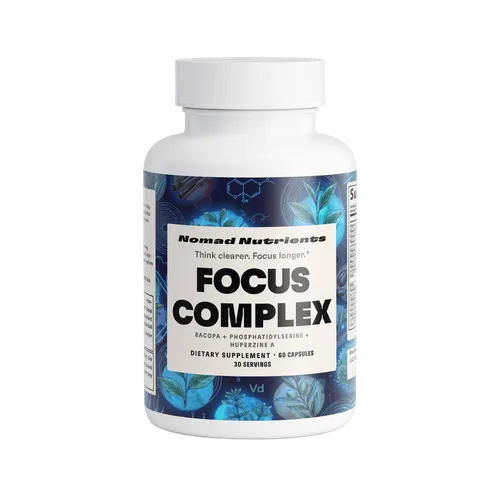
Huperzine A in the Nomad Stack
If sustained focus and memory support are your primary wellness goal, we've built a stack around it.
[[ INSERT STACK NAME + LINK ]]
References
- Yang G, et al. "Huperzine A for Alzheimer's disease: a systematic review and meta-analysis of randomized clinical trials." PLoS One, 2013.
- Rafii MS, et al. "A phase II trial of huperzine A in mild to moderate Alzheimer disease." Neurology, 2011.
- Xu SS, et al. "Efficacy of tablet huperzine-A on memory, cognition, and behavior in Alzheimer's disease." Acta Pharmacologica Sinica, 1999.
- Tang XC, et al. "Effect of huperzine A, a new cholinesterase inhibitor, on the central cholinergic system of the rat." Journal of Neuroscience Research, 1989.
- Wang R, et al. "Progress in studies of huperzine A, a natural cholinesterase inhibitor from Chinese herbal medicine." Acta Pharmacologica Sinica, 2006.